Written by Ron Cooke, President & Founder of Strategic Wealth Protection Partners in Ontario, CEA®, Member of the Estate Planning Council Canada
Does Canada Have an Estate Tax?
Canada doesn’t have an estate tax or inheritance tax.
But that doesn’t mean your estate avoids tax.
When you pass away, the Canada Revenue Agency (CRA) treats all your assets as if you sold them at fair market value on the day you died. This is called a deemed disposition, and it’s what creates most of the tax owing.
Your estate may need to pay tax on:
- Capital gains for properties that aren’t your primary residence.
- Non-registered investments that have grown in value.
- RRSPs and RRIFs, which are taxed as income unless they roll over to a spouse.
- Private-company shares or business assets that increase in value over time.
If you have significant wealth and hold multiple properties, a large investment portfolio, or a business, then your final tax bill can be substantial. In many cases, the estate ends up paying hundreds of thousands or millions in tax.
Your estate may also pay probate fees depending on your province. Ontario, BC, and Nova Scotia tend to be the highest.
The good news? There are many planning strategies, such as spousal rollovers, trusts, estate freezes, and life insurance strategies that can significantly reduce the tax your estate pays.

Key Points:
- Canada has no estate tax or inheritance tax.
- Your estate pays income tax based on a “deemed disposition” of assets at death, which can result in a substantial tax burden.
- Capital gains on cottages, rental properties, investments, and businesses can create a massive tax bill.
- For a real estate investor with multiple properties, taxes can easily exceed $500k–$2M.
- RRSPs and RRIFs are taxed as income unless rolled over to a spouse.
- For a $1M RRSP, tax could exceed $400k.
- Probate and estate administration fees vary by province and can cost tens of thousands of dollars.
Does Canada Have an Estate Tax?
Canada does not have a traditional estate tax.
However, when someone passes away, their assets are treated as if they were sold on the date of death, which creates a tax liability on the deceased’s final tax return. This often results in a significant tax burden, especially for those with large investment portfolios or multiple properties.
While the term estate tax is often used informally, the tax actually comes from income tax and capital gains tax, not a separate estate tax system.
Does Canada Have an Inheritance Tax?
Canada does not charge a gift tax or a traditional inheritance tax.
Beneficiaries do not pay tax simply for receiving an inheritance. However, taxes arising from the deceased’s final tax return must be settled before beneficiaries receive any assets, and this can still reduce the total value of the inheritance.
The key is understanding how Canadian inheritance tax laws work in practice, even without an actual inheritance tax.
What Is an Estate in Canada?
An estate in Canada includes everything an individual owns at the time of death.
This includes real property, investments, bank accounts, vehicles, and all forms of personal property. Once someone passes away, all assets must be valued at fair market value, and those values are used to calculate taxes, probate costs, and distributions under a will.

How Does the Final Tax Return Upon Death Work in Canada?
When someone dies, a final tax return must be filed, and this is often where the largest tax hit occurs.
The CRA considers most assets to be sold at fair market value at the date of death, triggering capital gains tax on investment properties and non-registered accounts.
RRSPs and registered retirement income funds are also fully taxable as income unless transferred to a spouse or qualifying dependent. These taxes are paid by the estate, not the children, and they can significantly reduce the inheritance if planning is not in place.
Who Pays Taxes When Someone Dies in Canada?
The estate is responsible for all unpaid taxes owed by the deceased.
Beneficiaries do not pay tax on what they receive unless the asset itself generates income in the future. The estate trustee uses estate funds to pay taxes before anything is distributed, whether the asset is cash, investments, or property.
How Do Capital Gains on Inherited Property Work?
When property is inherited in Canada, capital gains tax is applied based on the fair market value at the date of death.
If the property was not the principal residence, the gain from the time the deceased purchased it to the date of death is taxed on the final return. If the beneficiary later sells the property and its value has increased, they may face additional capital gains at that time.
Are Life Insurance Proceeds Taxable?
Life insurance benefits are generally not taxable as income in Canada.
When a beneficiary is named, the payout bypasses probate and avoids probate fees entirely. However, if the estate is named as beneficiary, the proceeds may be subject to probate and could be used to settle estate debts and taxes.

What Are Probate Fees in Canada?
Probate is a legal process that validates a will and gives the estate trustee authority to manage the estate.
In Ontario, this cost is known as the estate administration tax, which is calculated based on the total value of the estate assets that must go through probate. The higher the estate value, the higher the probate fees, making probate planning essential.
Taxes on RRSPs and Retirement Accounts
RRSPs, RRIFs, and similar registered accounts are fully taxable as income on the final return unless transferred to a surviving spouse or dependent child.
This can create one of the largest tax liabilities in an estate. If no rollover is available, the full value of the RRSP or RRIF is added to the deceased’s income for that tax year.
Tax-Free Rollovers to a Spouse or Common-Law Partner
Certain assets like RRSPs, RRIFs, and capital property can transfer to a surviving spouse or common law partner without immediate tax.
This rollover defers taxes until the spouse passes away or disposes of the asset. Spousal rollovers are one of the most valuable tools available to reduce taxes at death.
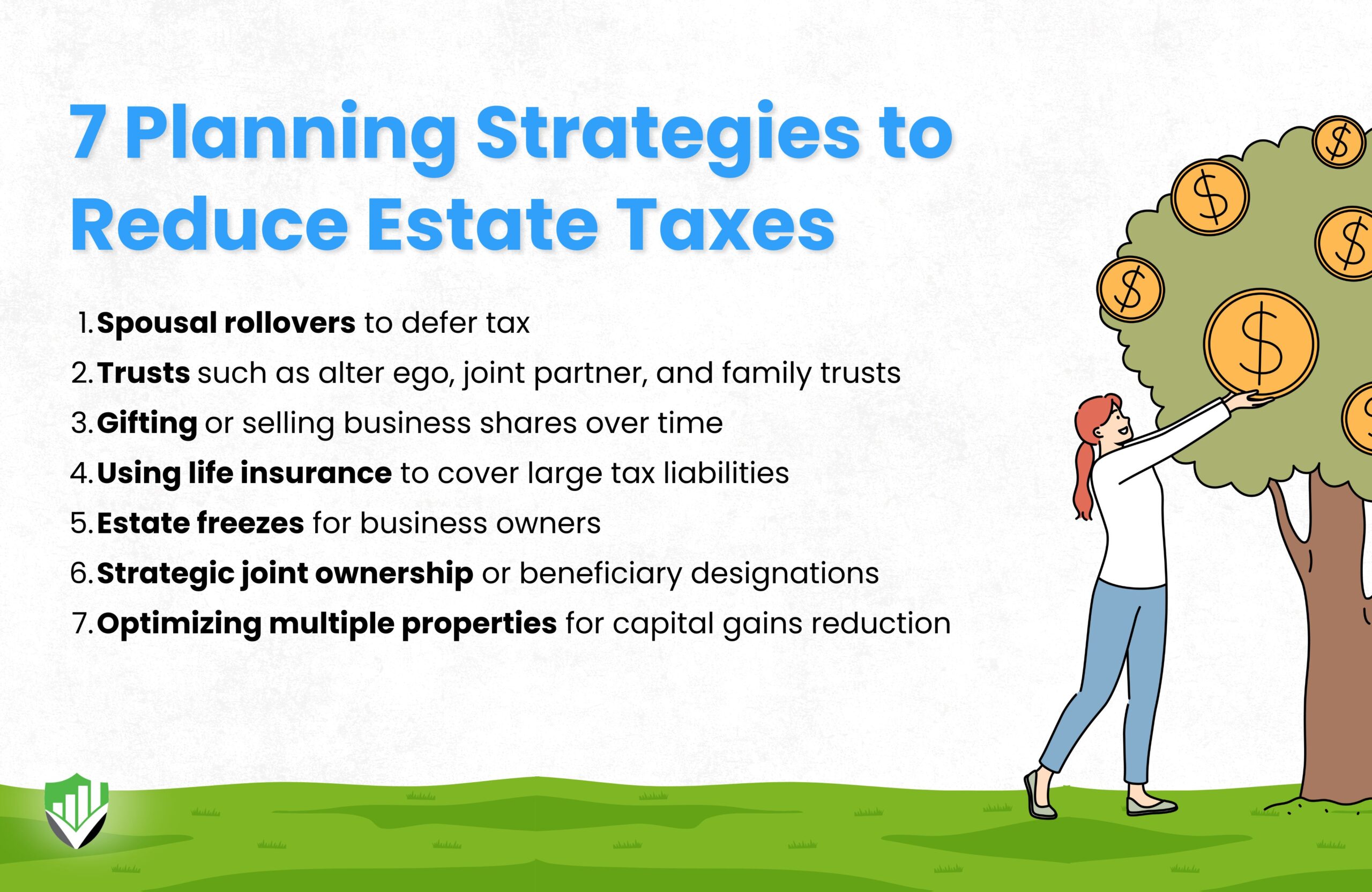
Planning Strategies to Reduce Estate Taxes
If you have a large estate, you should work with an estate planning professional in your province or territory. These are some estate planning strategies that can be used to reduce estate taxes:
- Using spousal rollovers to defer tax
- Using trusts such as alter ego, joint partner, and family trusts
- Gifting or selling shares of a business over time
- Life insurance to cover large tax liabilities
- Estate freezes for business owners
- Joint ownership or beneficiary designations can be used strategically
- Using multiple properties optimally for capital-gains reduction (e.g., principal residence exemption planning)
Resource: Estate Freezes
Common Questions
It allows property to transfer directly to the surviving owner without probate. Only assets held jointly with survivorship rights qualify.
Debts must be paid by the estate before beneficiaries receive anything. If the estate has insufficient funds, some debts may remain unpaid.
There is no limit because Canada does not tax inheritances. Taxes arise only from the deceased’s final return.
You cannot avoid capital gains, but you can minimize tax through trusts, joint ownership, and planning for the principal residence exemption.
The CRA can reassess the estate’s tax filings for up to three years after issuing a notice of assessment. This makes accurate reporting essential.
Real Case Study: How We Helped Ahmad Reduce His $6 Million Estate Tax Bill and Keep His Legacy Intact
Ahmad* spent his life building a stable future, not just for himself, but for his three children.
As a divorced father and the sole owner of a corporation holding ten multi-unit rental properties, he had one clear goal: to ensure that his kids could inherit the company, continue managing the portfolio, and live off the rental income for years to come.
But there was a problem.
At his passing, Ahmad’s estate would face an estimated $6 million tax bill, driven by capital gains, the deemed disposition of corporate shares, and the tax liability triggered at death under Canadian tax rules. Without a proper plan, the business would need to sell assets or borrow funds, breaking apart the legacy Ahmad worked so hard to build.
The Plan: Freeze, Fund, and Future-Proof
To protect the estate and reduce the future tax burden, we collaborated with our advanced tax planning team to implement a multi-layered strategy:
- Estate Freeze: We froze the value of Ahmad’s current shares, locking in his tax exposure today and shifting all future growth to a newly created family trust that benefits his three children.
- Wasting Freeze: We added a mechanism to gradually reduce the value of Ahmad’s taxable frozen shares over time, lowering the tax burden at death even further.
- Life Insurance Strategy: A permanent life insurance policy was set up to fund the estate’s tax liability, providing liquid capital so the children wouldn’t need to sell properties to pay the CRA.
- Secondary Will: This additional will was used to exclude private company shares from probate, helping avoid unnecessary probate fees and court delays.
The Outcome
Ahmad’s plan is now in place, and it’s working.
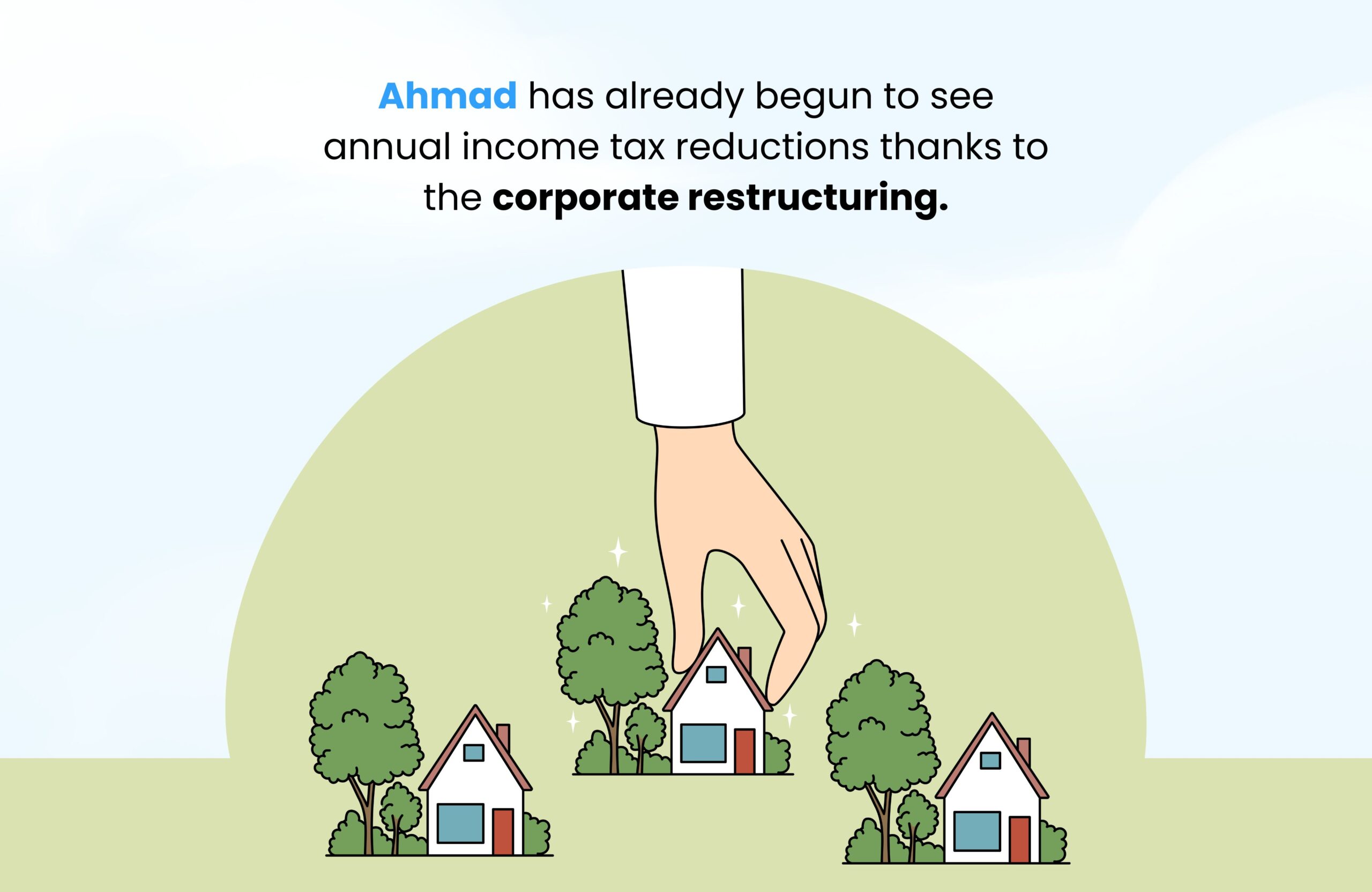
He has already begun to see annual income tax reductions thanks to the corporate restructuring. More importantly, his children will inherit the company with no forced sales, no liquidity scramble, and no surprise tax shocks. The business remains fully intact, and the income it produces will continue to support the next generation, just as Ahmad intended.
His only regret? He wishes he had done it sooner.
*Names and identifying details have been changed to protect the identity of SWPP’s client.
Discover How to Minimize Taxes and Secure Your Legacy
Did you know that without a solid estate plan, taxes and fees in Ontario could claim a significant portion of your wealth?
If you’ve worked hard to build your business, investments, and properties, protecting your legacy for your loved ones is critical. At Strategic Wealth Protection Partners, we specialize in helping high-net-worth individuals in Ontario secure their financial futures.
Our Living Estate Plan is designed to:
- Reduce estate taxes and probate fees.
- Simplify wealth transfer to your loved ones.
- Reflect your values and priorities in every detail.
Your Legacy Matters
With our personalized guidance, we’ll help you navigate options like Living Trusts to protect your assets and ensure your family’s peace of mind. Contact us today to book your Living Estate Plan Consultation and take the first step toward a secure future.
Schedule a Living Estate Plan Consultation
Planning your legacy is about more than numbers—it’s about ensuring your family remembers you and your values are honoured for many years to come.
Estate planning and trusts can feel overwhelming, especially if it’s your first time. That’s why we’re here.
With our simple, 5-Step Living Estate Plan, we make the process easy, helping you create a comprehensive estate plan or trust that protects your assets from taxes and probate fees while preserving your legacy. Tools like The Final Word Journal capture your story, wishes, and essential details like accounts and end-of-life plans, ensuring your family has clarity and comfort.
Take the first step today—schedule a consultation call and give your family the ultimate gift: peace of mind and the assurance they were always your priority.
Read More
If you’re starting your estate planning process, you may find these articles helpful:
- Estate Planning Ontario: A Simple Guide to Getting It Right
- Estate Tax Canada Guide
- Death Tax Canada: How to Avoid a Surprise Tax Hit
- How to Avoid Estate Tax in Canada in 2025
- Estate Planning Ontario Checklist
About the Author
RON COOKE, PRESIDENT & FOUNDER OF STRATEGIC WEALTH PROTECTION PARTNERS

With over 30 years in financial services, I’ve seen the challenges families face when a loved one passes—lost assets, unnecessary taxes, and emotional stress. That’s why I created the Living Estate Plan, a comprehensive process to protect assets, eliminate estate and probate fees, and create legacies that are remembered for many years to come.
This plan ensures your family receives not just your wealth, but a meaningful reminder of your care and love. Tools like The Final Word Journal capture your story, wishes, and essential details, offering clarity and comfort during difficult times.
Your final gift should be more than money—it should be peace of mind, cherished memories, and an organized estate.
Schedule a Call
Schedule a 30-minute consultation call with Strategic Wealth Protection Partners.
Click HERE to schedule a consultation.