Written by Ron Cooke, President & Founder of Strategic Wealth Protection Partners in Ontario, CEA®, Member of the Estate Planning Council Canada
Probate is required in Ontario when a financial institution, land registry office, or other authority needs legal proof that a will is valid and that the executor has the right to act on behalf of the estate.
This usually happens when the deceased owned assets in their name alone. If the deceased owns assets such as a house, bank accounts, investment accounts, or business shares in their name alone, probate will likely be required.
Key Takeaways:
- Probate is required on most assets that are in your name alone, especially real estate (unless jointly owned with right of survivorship), corporate shares, and investment accounts without named beneficiaries.
- Joint ownership and named beneficiaries can avoid probate, but must be set up correctly to avoid unintended tax or family-law consequences.
- Ontario does not have a probate value threshold, so even small estates may require probate if a financial institution demands it.
- Complex estates, such as multiple properties and corporations, almost always require probate unless extensive planning has been done.
- Estate Administration Tax is unavoidable when assets pass through probate, but proper planning can help you reduce this tax.
- If someone dies without a will, probate is almost always required. The process becomes longer, more expensive, and less controlled.
- Planning ahead can reduce the probate burden, including dual wills for business owners, beneficiary designations, trusts, and joint ownership planning.
What Is Probate in Ontario?
Probate in Ontario is the court process that confirms a will is legally valid and gives the estate trustee (executor) the official authority to act on behalf of the estate.
Without probate, most financial institutions, land registry offices, and investment firms will not release assets or allow property to be transferred. As part of this process, the estate must also pay the Estate Administration Tax, which is calculated on the value of all assets that pass through probate. Probate acts as a legal safeguard, ensuring the will is authentic, the executor is properly appointed, and the estate is managed according to Ontario law.

When Is Probate Required in Ontario?
If a deceased person’s assets do not automatically pass to someone else, and an institution needs “proof of authority,” probate becomes necessary.
You generally need probate when:
- The deceased owned real estate in their name only
- There are investment accounts without named beneficiaries
- Bank accounts are held individually (not joint)
- Financial institutions refuse to release funds without probate
- The estate includes corporate shares
- The estate includes private company shares held personally
- There are multiple properties, rental properties, or a cottage
- There are estate assets in another province or country
- There is no will, or the will is outdated or unclear
- There are multiple wills
- The will has handwritten changes or is missing pages
- There is a dispute or even a potential dispute among beneficiaries
- There is a trust named in the will
- The executor lives outside Ontario or is not a resident of Canada
- When someone dies with joint ownership, but the joint ownership was for convenience only
- When there are digital assets or online accounts that hold monetary value
📖 Read More: How Much Does an Estate Have to Be Worth to Go to Probate in Ontario?
When Is Probate Not Required in Ontario?
You generally don’t need probate when:
- Assets are joint with right of survivorship (spouse or adult child)
- Assets have a named beneficiary (life insurance, RRSP, RRIF, TFSA, some non-registered accounts)
- The property qualifies for the first dealing exemption
- The estate is very small and financial institutions agree to release funds without probate
- There is a valid second will covering corporate assets (common for business owners)
- The will includes a beneficiary designation for non-registered investment accounts
- Assets are held in a trust created before death
- The value of a small account is under the bank’s internal release threshold
For most people with a larger estate with multiple properties, significant investments, or a corporation, probate is required unless careful estate planning has been done.
What Happens If There Is No Will in Ontario?
When someone dies without a will in Ontario, the estate is distributed according to the Succession Law Reform Act, not the deceased’s personal wishes.
In this case, the court must appoint an estate trustee without a will, who will have the person’s legal authority to administer the deceased’s estate. This can be a slow and stressful legal process for loved ones, especially if there are disagreements among family members.
The law determines who inherits, starting with the surviving spouse, followed by children, then more distant relatives. If no next of kin are found, the estate may even go to the Ontario government. Without clear instructions, important decisions about personal property and real property are left to legislation and the courts, not to your family.
📖Read More: What Is a Living Will in Ontario?
How Is the Estate Administration Tax in Ontario Calculated?
In Ontario, probate fees are known as the Estate Administration Tax.
This tax is calculated based on the total value of the estate assets that go through probate.
The first $50,000 is tax-free. For everything above that, the estate pays 1.5 percent. So, for a $1 million estate, the tax is approximately $14,250.
The estate trustee is responsible for filing the Estate Information Return within 180 days of the probate certificate being issued. The tax must be paid at the time of the application, or shortly after. Accuracy matters; underreporting can lead to penalties.
Ontario Probate Fee Calculator
Steps to Take Before Applying for Probate
Before starting the probate application, several steps need to happen to ensure a smooth legal process.
First, locate the will because this confirms the estate trustee’s legal authority. If no will exists, a court application must be made for someone to be appointed.
Next, take time to identify and value all assets, including real property, bank accounts, investments, and personal property like vehicles or jewelry. Outstanding debts and liabilities must also be reviewed. This information will form the basis of the probate application and the Estate Information Return.
Completing these steps properly up front avoids complications later in the probate process.
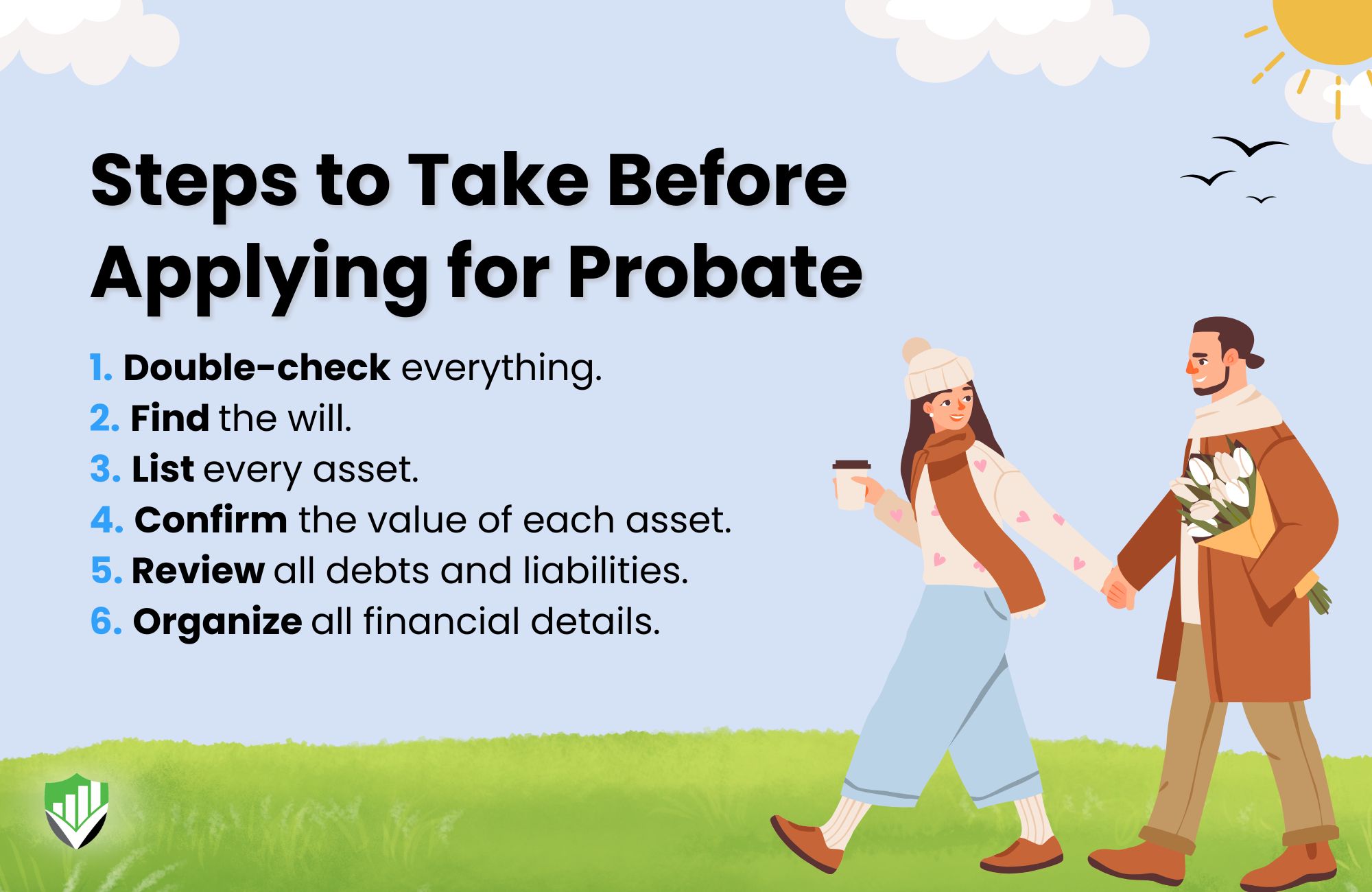
- Double-check everything.
- Find the will.
- List every asset.
- Confirm the value of each asset.
- Review all debts and liabilities.
- Organize all financial details.
How to Apply for Probate in Ontario
To apply for probate in Ontario, the estate trustee must file several key forms with the Ontario Superior Court of Justice. These include:
- Application for a Certificate of Appointment of Estate Trustee with or without a Will
- An original copy of the will (if one exists)
- An affidavit of service and list of beneficiaries
- An estate inventory, including the value of all personal and real property
The application is submitted to the court in the jurisdiction where the deceased resided. Once approved, the court grants a Certificate of Appointment, giving the trustee authority to manage the deceased’s estate.
What Happens After Probate Is Granted?
Once probate is granted, the estate trustee has full legal authority to act on behalf of the estate.
Their responsibilities include securing and managing all assets, settling outstanding debts, filing the final tax return, and eventually distributing the estate according to the will or Ontario law.
This stage often takes several months and requires careful record-keeping and communication with beneficiaries. The trustee must also keep detailed financial records and may need to pass accounts through court, especially in more complex estates.
How Does Probate Work for Out-of-Province Assets?
If the deceased’s estate includes assets located outside Ontario, such as real property or bank accounts in another province or country, a secondary probate (also called ancillary probate) may be needed in that jurisdiction.
Each province and country has its own laws, and Ontario’s probate certificate may not automatically be recognized elsewhere. In these cases, the estate trustee may need legal assistance to access or sell those out-of-province assets. Planning in advance can help reduce duplication and delays.

How Long Does Probate Take in Ontario?
In Ontario, probate typically takes 4 to 6 months from the time of application, if everything is in order.
However, it can be delayed by missing paperwork, family disputes, tax complications, or problems valuing the estate. More complex estates or those without a will can take a year or more. Clear communication and accurate documentation can speed up the process.
When to Get Help from a Professional
Probate can be overwhelming, especially when the estate involves businesses, blended families, or out-of-province real property.
If you are unsure of your responsibilities as an estate trustee, it’s wise to consult an estate lawyer, an accountant, or an estate planner. They can help you interpret the will, complete the probate forms, file taxes, and avoid costly mistakes, especially when large estates or complex tax issues are involved.

Common Questions
Typically, 4 to 6 months, but complex estates can take longer depending on documentation, disputes, or tax issues.
The person named as estate trustee in the will (or if there is no will, a close family member or spouse) must apply to be appointed by the court.
You should apply once the will is located and you have valued the estate. Probate is needed before distributing or managing assets.
The fair market value of all estate assets is calculated as of the date of death. This includes real property, personal property, bank accounts, and investments. Accurate valuations are crucial for determining probate fees and ensuring CRA compliance.
There is no minimum threshold. Even small estates may require probate if a bank or financial institution asks for court authority.
As of now, there are no confirmed rule changes for 2025 or 2026, but updates could occur. It’s important to stay informed through reliable legal sources.
Let’s say a Mom adds a daughter to a bank account “to help pay bills,” but the Mom is the true owner. Then the mother passes away. The bank will freeze the account and demand probate unless the executor can prove the joint account was a true right-of-survivorship asset. If not, probate is typically required. This is one of the most common estate litigation issues in Ontario.
Let’s say that the deceased leaves behind cryptocurrency, PayPal or Wise balances, online trading platforms, and online businesses with seller accounts that hold real value? Digital financial platforms do not release control without probate unless the deceased left clear access instructions and legal documentation.
You can reduce or avoid probate by naming beneficiaries on registered accounts, holding property jointly with right of survivorship, or using trusts to pass on assets outside of the deceased’s estate.
Client Case Study: Avoiding Probate for Ellen’s Estate
Background
Ellen* is a 71-year-old retired widow living in Ontario.
She has no debt and has done well for herself financially. Her estate includes a RRIF valued at $1.9 million, a TFSA worth $175,000, non-registered investments of $1.5 million, and a fully paid-off home valued at $1.2 million.
She lives independently and wanted to ensure that her estate would be passed down smoothly to her adult children without unnecessary legal delays or costly probate fees.
Assets Include:
- RRIF – $1.9M
- TFSA – $175k
- Non-registered investments – $1.5M
- Home, fully paid off – $1.2M valuation
The Problem
Ellen came to SWPP (Strategic Wealth Protection Partners) with a clear concern: she wanted to avoid probate to the greatest extent possible.
She understood that probate in Ontario could delay the distribution of her estate and result in significant probate fees, especially given the size of her real property and non-registered investments. She had heard from friends that estates can be tied up in court for months, or even longer and that the legal process could become difficult for her children at an emotional time.
With no estate trustee named yet and no structure in place to minimize the value of the estate that would pass through probate, Ellen knew she needed guidance and a plan tailored to Ontario law.
SWPP’s Solution
SWPP designed a comprehensive estate planning strategy to reduce the exposure of her assets to probate and income tax. Here’s what SWPP helped Ellen put in place:
- Her RRIF was set up to name her surviving spouse, but as she is widowed, SWPP guided her to name her children directly as beneficiaries, ensuring that the proceeds would bypass her estate and avoid probate.
- Her TFSA already had a named beneficiary, but SWPP confirmed and documented this correctly to ensure no errors.
- For her non-registered investments, SWPP helped her transfer a portion into a joint investment account with right of survivorship, effectively removing those assets from her estate while maintaining control.
- SWPP introduced a trust strategy to shelter a portion of her investments, removing them from her deceased’s estate and protecting them from probate entirely.
- The final step was to address her home. Rather than gifting it (which would trigger capital gains tax), SWPP explored whether a trust or eventual joint ownership might suit her needs, weighing the pros and cons carefully before she made a decision.
The Results
With these steps, SWPP was able to significantly reduce the portion of Ellen’s estate that will be subject to probate fees.
Her largest assets now have a clear succession plan that bypasses the courts. She also has peace of mind knowing her estate is set up in a way that reflects her values and minimizes stress for her children.
Ellen’s estate is now structured to reduce the legal burden on her family, lower her final tax bill, and avoid court delays, all while keeping her in full control during her lifetime.
Where She Is Now
Ellen told the team at SWPP that she finally feels at ease.
Her documents are in place. Her estate is protected. And most importantly, her children won’t be burdened with legal red tape or expensive delays. She now enjoys her retirement with confidence, knowing that the legacy she’s built will be preserved and passed on efficiently.
*Names and identifying details have been changed to protect the identity of SWPP’s clients.
Discover How to Minimize Taxes and Secure Your Legacy
Did you know that without a solid estate plan, taxes and fees in Ontario could claim a significant portion of your wealth?
If you’ve worked hard to build your business, investments, and properties, protecting your legacy for your loved ones is critical. At Strategic Wealth Protection Partners, we specialize in helping high-net-worth individuals in Ontario secure their financial futures.
Our Living Estate Plan is designed to:
- Reduce estate taxes and probate fees.
- Simplify wealth transfer to your loved ones.
- Reflect your values and priorities in every detail.
Your Legacy Matters
With our personalized guidance, we’ll help you navigate options like Living Trusts to protect your assets and ensure your family’s peace of mind. Contact us today to book your Living Estate Plan Consultation and take the first step toward a secure future.
Schedule a Living Estate Plan Consultation
Planning your legacy is about more than numbers—it’s about ensuring your family remembers you and your values are honoured for many years to come.
Estate planning and trusts can feel overwhelming, especially if it’s your first time. That’s why we’re here.
With our simple, 5-Step Living Estate Plan, we make the process easy, helping you create a comprehensive estate plan or trust that protects your assets from taxes and probate fees while preserving your legacy. Tools like The Final Word Journal capture your story, wishes, and essential details like accounts and end-of-life plans, ensuring your family has clarity and comfort.
Take the first step today—schedule a consultation call and give your family the ultimate gift: peace of mind and the assurance they were always your priority.
Read More
If you’re starting your estate planning process, you may find these articles helpful:
- How Much Does an Estate Have to Be Worth to Go to Probate in Ontario?
- What Assets Are Not Subject to Probate in Canada?
- Who Pays Probate Fees in Ontario?
- What Is the Best Trust to Avoid Probate in Canada?
About the Author
RON COOKE, PRESIDENT & FOUNDER OF STRATEGIC WEALTH PROTECTION PARTNERS

With over 30 years in financial services, I’ve seen the challenges families face when a loved one passes—lost assets, unnecessary taxes, and emotional stress. That’s why I created the Living Estate Plan, a comprehensive process to protect assets, eliminate estate and probate fees, and create legacies that are remembered for many years to come.
This plan ensures your family receives not just your wealth, but a meaningful reminder of your care and love. Tools like The Final Word Journal capture your story, wishes, and essential details, offering clarity and comfort during difficult times.
Your final gift should be more than money—it should be peace of mind, cherished memories, and an organized estate.
Schedule a Call
Schedule a 30-minute consultation call with Strategic Wealth Protection Partners.
Click HERE to schedule a consultation.